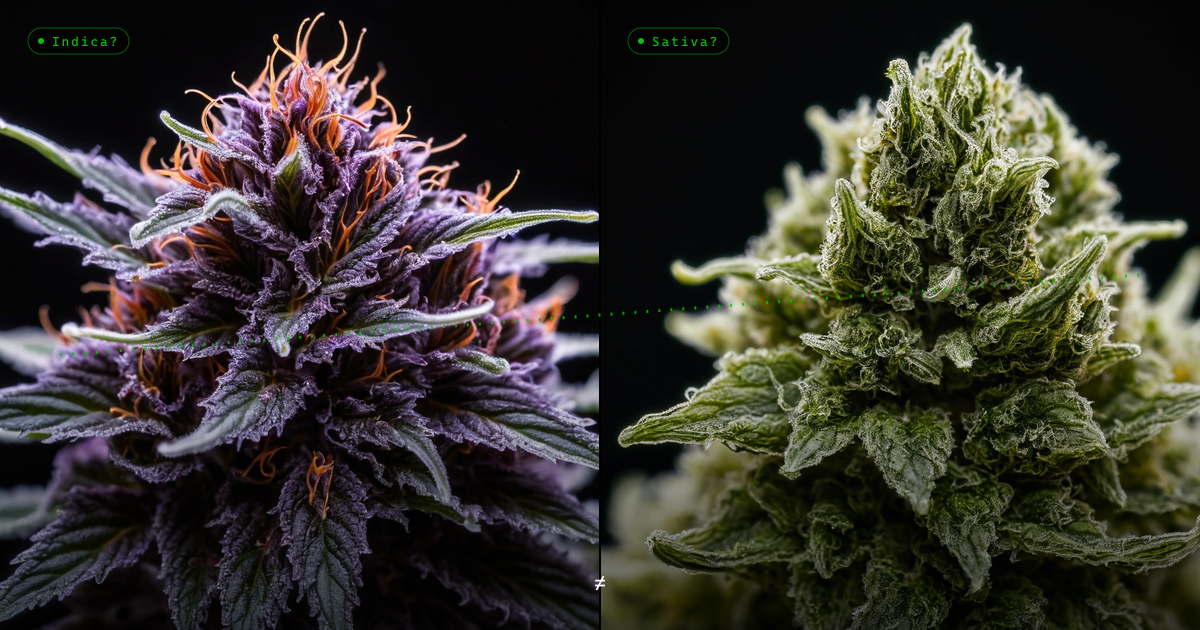
Indica vs Sativa: Why It Often Does Not Match Real Life
Breaking down the limitations of the most common labels and why experience is multidimensional.
The indica/sativa classification is perhaps the most widely used — and most misleading — framework in the botanical world. Originally, these terms described the physical morphology of the plant: broad leaves versus narrow leaves, short bushy plants versus tall spindly ones.
Over decades of cross-breeding, the genetic lines between indica and sativa have blurred beyond recognition. Most modern cultivars are hybrids with complex genetic backgrounds. The idea that indica always means sleepy and sativa always means energetic is a dramatic oversimplification.
Research consistently shows that the subjective effects of a cultivar are determined by its complete chemical profile — the specific ratios of cannabinoids, terpenes, and flavonoids — rather than its indica or sativa classification.
A more useful framework focuses on the dominant terpene profile and cannabinoid ratios. This is why Leaf ID categorizes experiences by observed effects and terpene patterns rather than relying solely on the indica/sativa binary.